AI overview
If a gross vehicle mass (GVM) upgrade takes your ute, van or truck outside OEM spec, the original equipment manufacturer's production specs, tell your insurer and keep the certificate. If you do not and you have a claim, it could be a grey area, and you can be paid out on the value of the vehicle before the upgrade.
Key highlights
- Tell your insurer about a GVM upgrade if it takes the vehicle outside OEM spec, which is the original equipment manufacturer's production specs, and keep the certificate for the upgrade.
- If the upgrade had something to do with the accident and you did not declare it, you would probably be declined. If it had nothing to do with it, the claim may still be paid, but likely on the value before the upgrade. It is not a black and white answer.
- An upgrade usually adds value. In this example, a $100,000 Land Cruiser with a $25,000 GVM upgrade, a bull bar and other accessories is probably worth $140,000, and you need the invoices to justify it.
- The premium can change after an upgrade, mainly because there is more value in the vehicle.
- On a fleet policy, every vehicle upgraded outside OEM spec has to be noted individually.
- Past 4.5 tonnes GVM a car licence no longer covers the vehicle, and the driver needs at least a light rigid (LR) licence.
- Before you book the upgrade, ask your broker whether it is insurable and inside safe specs.
Summarise with AI
Open this article in your AI assistant for a quick summary.
A GVM upgrade lifts the gross vehicle mass (GVM) of your ute, van or truck, which is the most it is rated to weigh with its load on board.
Do you have to tell your insurer? You should, if the upgrade takes the vehicle outside OEM spec, the original equipment manufacturer's production specs. A modification changes the risk, and as your broker I want to see the certificate for the GVM upgrade.
If you do not tell them, what happens at claim time depends on what caused the accident, and you can be paid out on the value of the vehicle before the upgrade.
Do You Have to Tell Your Insurer About a GVM Upgrade?
You should tell your insurer if the upgrade takes the vehicle outside OEM spec, the original equipment manufacturer's specs, which are the production specs the vehicle was built to.
The reason is risk. A modification changes the risk, and as your broker, I want to see the certificate for the GVM upgrade.
If you did not tell them, it depends. Say the upgrade was done properly and certified, but you did not let the insurer know. If you then made a claim, it would be a grey area, and you would have to clarify it with the insurer.
GVM, or gross vehicle mass, is the most a vehicle is rated to weigh fully loaded: the vehicle, fuel, people, accessories and load together. A GVM upgrade raises that rating, usually with upgraded suspension or chassis work, and usually comes with a certificate for the new rating.
What Happens at Claim Time If You Did Not Declare It
Say you rolled off the road. The first question would be whether the upgrade caused it. If it did, you would probably be declined, because you did not let the insurer know and it did not get to do its due diligence, the checks an insurer makes before it agrees to cover something.
If someone ran you off the road, there is no cause and effect: the accident had nothing to do with the GVM upgrade. Even then, it is not a black and white answer.
A GVM upgrade usually increases the vehicle's market value, what it would sell for, and its agreed value, the amount you and the insurer agree it is worth. If you do not let the insurer know, you will not be paid out on that higher value.
GVM Upgrades and Agreed Value: The Land Cruiser Example
I usually recommend agreed value. Say I bought a Toyota Land Cruiser for $100,000, then had a GVM upgrade done. That might cost an extra $25,000, plus a bull bar and the other gear that adds weight. The vehicle is now probably worth $140,000.
So you would increase its value on the policy. To go from $100,000 to $140,000, you need to justify it with invoices. The insurer will want to know why the vehicle is worth that, and a new radio and a couple of headlights will not explain it.
| Item | Amount |
|---|---|
| Land Cruiser purchase price | $100,000 |
| GVM upgrade | About $25,000, plus bull bars and other gear |
| Value after the upgrade | Probably $140,000 |
Agreed value is the amount you and the insurer agree the vehicle is worth when the policy is set up. Usually, go with agreed value, and justify it with invoices. Market value is what the vehicle would sell for at the time of the claim.
What Counts as a Modification?
A modification is more than a new set of car mats or a stereo. On a light vehicle, it might be an upgraded chassis to carry extra weight, or upgraded suspension.
On a bigger truck, a prime mover might be upgraded all round, including the brakes and chassis, to lift its towing rating from 90 tonnes to a higher one or to increase its performance.
Either way, it is a change outside the OEM specs, and it usually comes with a certificate or a document saying what has been done. The work also has to stay inside safe specs and the modifications allowed for that vehicle.
- An upgraded chassis for extra weight.
- Upgraded suspension, the springs and shocks that carry the load.
- Brake upgrades.
- A higher towing rating on a prime mover, for example above 90 tonnes.
- Work that increases the vehicle's performance.
Accessories: The Fridge, the Bull Bar and the Lights
The main thing is to get your accessories and modifications noted, so they are covered at claim time. Say you pay $80,000 for a light vehicle, or $150,000 for a truck, and then fit a fridge, exhaust pipes, a bull bar, lights and a radio.
If you paid $150,000, spent another $50,000 fitting it out and did not tell anyone, you will be paid $150,000 at claim time. The $50,000 fit-out is not covered, and you are going to be upset.
Leaving them off does not save you much. You might save a little on the premium, but you lose everything you spent on the modifications.
If the modifications are a grey area, they might not be paid out at all, when you could have just let us know. And that modification might have cost you $20,000.
GVM Upgrades on Trucks and Prime Movers
It is the same for trucks. Say your prime mover is rated to tow 90 tonnes, or 110, and an upgrade takes it to 140.
Again, the insurer will ask what you were towing at the time, what caused the accident, what the outcome was, and whether the upgrade had anything to do with it.
If you are rated to 90 tonnes and towing 140, there is an issue. The insurer will point out that you had an upgrade and never told it. You will probably be paid out on the 90 tonne rating, because that is what you paid premium on.
On a prime mover, a towing rating like 90 tonnes is its gross combination mass, or GCM: the most the truck and everything it tows can weigh together, where GVM is the truck on its own. Both ratings are set by the manufacturer and can be changed by a certified upgrade. Truck insurance covers rigid trucks and prime movers, and prime mover insurance is the cover for the truck doing the towing.
Over 4.5 Tonnes Gross Vehicle Mass: New Policy or New Licence?
You most likely do not need a different policy. It depends on the other vehicles in your fleet, but you do need to let the insurer know.
Licensing is run by each state and territory under its own regulations, but the classes line up: a car (C) licence covers vehicles up to 4.5 tonnes GVM, and over that the driver needs at least a light rigid (LR) licence.
In WA, Victoria and the ACT, for example, you need to have held a car licence for at least 12 months before you can get an LR. Check your own state's transport department before an upgrade takes a ute or van over the line.
- NSW: licence classes from the NSW Government
- Victoria: heavy vehicle licence categories from the Department of Transport and Planning
- Queensland: licence types and classes from the Queensland Government
- WA: light rigid licence from the Department of Transport
- SA: driver's licence classes from the SA Government
- Tasmania: licence classes from Transport Tasmania
- NT: heavy vehicle licence classes from the NT Government
- ACT: getting a heavy vehicle licence from Access Canberra
| Licence class | What it covers |
|---|---|
| C (car) | Vehicles up to 4.5 tonnes GVM, seating up to 12 adults including the driver |
| LR (light rigid) | Rigid vehicles over 4.5 tonnes and up to 8 tonnes GVM |
| MR (medium rigid) | Rigid vehicles over 8 tonnes GVM with no more than 2 axles |
| HR (heavy rigid) | Rigid vehicles over 8 tonnes GVM with 3 or more axles |
Up to 4.5 tonnes GVM, a work ute is covered by ute insurance. If an upgrade takes it over 4.5 tonnes, tell your broker the new GVM. Depending on the rest of your fleet, it may stay on the same policy or need light truck insurance, which we arrange for rigid trucks over 4.5 tonnes.
Fleets: Every Upgraded Vehicle Gets Noted
Does a business with a few upgraded utes on a fleet policy have to declare each one? Yes. If they have been upgraded individually, each one has to be noted.
If a vehicle is outside OEM specs, the original equipment manufacturer's production specs, I want to know about it.
If you run several upgraded vehicles, get each one noted on your motor fleet insurance schedule, the list of vehicles on the policy, and give your broker its certificate and the invoices for its new agreed value.
Why Being Upfront With Your Broker Pays
One of the most important things you can do as the insured, the policyholder, is build a rapport with your broker. It is a two-way street and a partnership.
The more open you are with your broker, the clearer and easier the outcome when something happens. You are likely to get a better renewal, a better outcome on premiums and a better understanding of your cover. If you do not keep your insurer informed, that is a red flag, because it suggests a business that does not communicate well.
When you have an incident, you want your wheels back on the road and earning revenue as quickly as possible, as close as you can to where you were before. Having all the information up front is how you get there, whether that means a payout, a repair or a replacement vehicle.
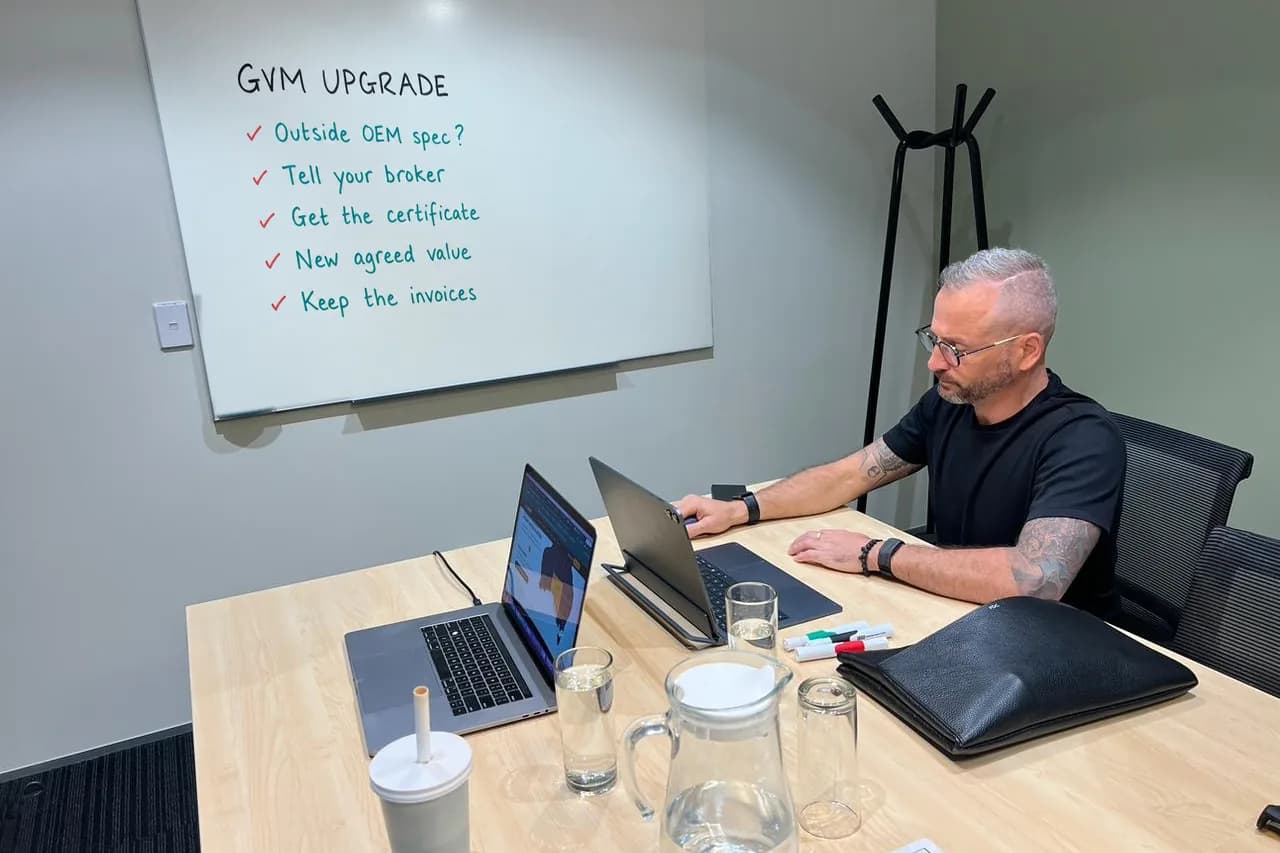
Put a process in place: every time you buy something, set its market or agreed value and share it with your broker. Your broker then updates the insurer.
What to Check With Your Broker Before You Book the Upgrade
Most people getting a modification done are not worried about the premium. They want to know whether the vehicle will still be insurable and inside safe specs once the work is done.
Will the premium go up? It can, mainly because the vehicle is worth more. But someone getting a modification done usually has a bigger reason for it. If the upgrade lets your prime mover tow more, that will outweigh whatever the premium is.
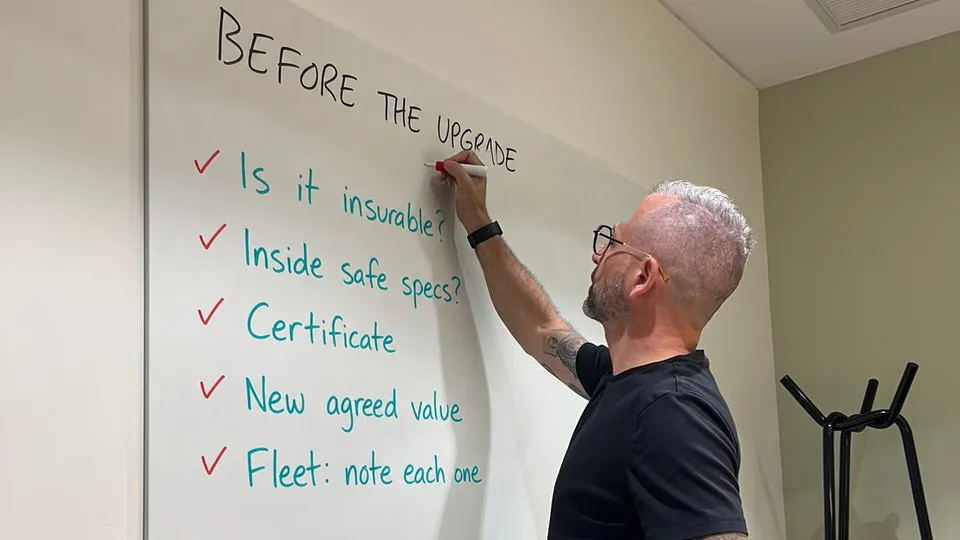
- Is the upgrade insurable?
- Is it inside safe specs and the allowed modifications for that vehicle?
- Will you get a certificate for the new rating?
- What is the new agreed value, and do you have the invoices for the upgrade and the accessories?
- If it is on a fleet policy, is this vehicle noted individually?
- Will the driver need a different licence class once the vehicle is over 4.5 tonnes GVM?
Frequently Asked Questions
A GVM upgrade raises a vehicle's gross vehicle mass (GVM), the most it is rated to weigh fully loaded: the vehicle, fuel, people, accessories and load together. It is usually done with upgraded suspension or chassis work, and it usually comes with a certificate for the new rating. If it takes the vehicle outside OEM spec, the original equipment manufacturer's production specs, tell your insurer.
Yes, if the upgrade takes the vehicle outside OEM spec, it changes the risk and usually the value, so tell your insurer and keep the certificate. The premium can change, mainly because there is more value in the vehicle. If you do not declare it, a claim can become a grey area.
You should, if it is outside OEM spec, the original equipment manufacturer's production specs. There has been a modification, so there is new risk, and the insurer will want the certificate for the GVM upgrade. Tell your broker before you book it.
It depends on what caused it. If the upgrade had something to do with the accident, for example a rollover, you would probably be declined because the insurer did not get to do its due diligence. If it had nothing to do with it, the claim may still be paid, but likely on the value before the upgrade.
It can, mainly because there is more value in the vehicle. But if you are getting a modification done, you are probably doing it for a bigger reason, and what you gain from carrying or towing more will outweigh whatever the premium is.
If the upgrade takes the vehicle over 4.5 tonnes GVM, a car licence no longer covers it and the driver needs at least a light rigid (LR) licence, which covers rigid vehicles over 4.5 tonnes and up to 8 tonnes GVM. Licensing is run by each state and territory, so check with your state's transport department.
GVM, gross vehicle mass, is the most the vehicle can weigh on its own with its load on board. GCM, gross combination mass, is the most the vehicle and everything it tows can weigh together, such as a ute and a caravan, or a prime mover and its trailers.
A change outside the OEM specs, such as an upgraded chassis for extra weight, upgraded suspension, brake upgrades, a re-rating on a prime mover or an increase in performance. These usually come with a certificate saying what has been done, and they have to sit inside safe specs.
Yes. Get accessories and modifications noted, so you are covered for them at the time of the claim. If you pay $150,000 for a truck and spend another $50,000 fitting it out without telling anyone, the payout is likely to be the $150,000.

Written by
Paul Cohalan
Founding Principal Broker, All Trucks Insurance
Paul is the founding principal broker at All Trucks Insurance, with more than 10 years broking transport, fleet and plant cover and an operational career in mining and heavy haulage before that.
Read Paul's full profile