
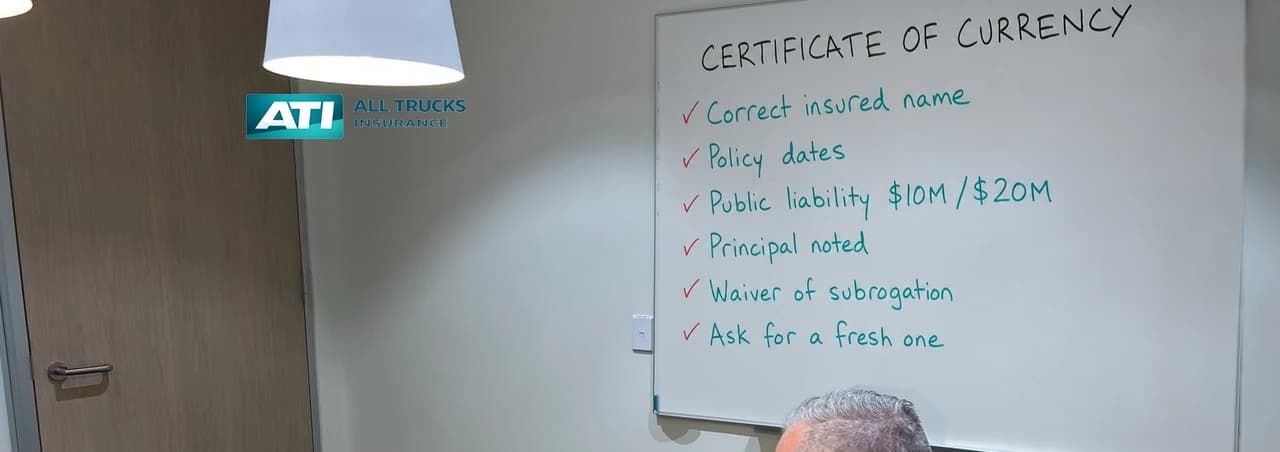
AI overview
A certificate of currency is the document you need to get on site, put in a tender and get your invoices paid. If the name or the dates are wrong, it gets sent back and you wait.
Key highlights
- A certificate of currency shows your cover is in place, the dates it runs and the correct insured entity.
- We usually produce one at renewal, and you will be asked for one for a new contract or tender, to get on a site, and when you finance a truck or a piece of equipment.
- Most clients ask for $10 million or $20 million in public and products liability, the cover for injury or property damage caused by your work or your products. Mining, construction and government work can ask for $30 million or $50 million.
- The mistakes that cause delays are errors in the business name, the dates or the spelling, and a principal, the business you are doing the work for, not being noted correctly.
- A certificate does not show the policy wording, which is the full terms and conditions, the exclusions, your claims or your premium, and an old one will not show changes made since renewal.
- Ask for it before you start the work. If you wait until the invoice is due and the certificate needs extra wording, your payment can be held up for a few days.
Summarise with AI
Open this article in your AI assistant for a quick summary.
A certificate of currency is a short document from your insurer that says your policy is in place: who is insured, the dates the cover runs, and the limits.
Why would a client ask for one? To confirm that the insurance is in place, the dates are right and it names the correct entity, which is the name of the insured business.
Without the right one, you might not get on site, your tender can be held up, and your invoices may not get paid.
When You Will Be Asked for a Certificate of Currency
We usually produce one at renewal as a matter of course. The other times you will be asked for one are when you are going for a contract with a new customer, need to get onto a site, or are putting in a tender.
You will also need one when you finance a truck, a trailer or any other equipment, because the lender wants to see the asset is insured before it releases the money.
The last is when you ask for an endorsement on the policy, which is a written change to the cover, or a client asks to be noted as a principal. We note it, and the certificate is time and date stamped to show it is current.
- At renewal, so you have a current one on file.
- Going for a contract with a new client.
- Getting access to a site, a quarry, a mine or a project.
- Putting in a tender.
- Applying for finance on a truck, transport or equipment.
- Adding an endorsement, noting a principal, or adding a waiver of subrogation.
A principal is the business you are doing the work for, usually the head contractor or the client whose job it is. Being noted as a principal means their name goes on your policy. A waiver of subrogation means your insurer agrees not to chase that principal to get back money it has paid out on a claim.
Public Liability Certificate of Currency: What Limits Clients Ask For
Clients usually require $10 million or $20 million in public and products liability, which is the cover for injury to people or damage to property caused by your work or your products.
Some contracts ask for $30 million or $50 million, usually in mining, construction or government work, because the exposure is much bigger.
Some insurers will raise the limit to $30 million or $50 million. Otherwise, we arrange an excess layer, which is a second policy that sits on top of the first.
An excess layer only pays once the first limit is used up. We use one because the primary layer can come from one insurer and the excess layer from another, which spreads the risk. We arrange the higher limits as part of your transport liability insurance.
What a Certificate of Currency for a Truck Looks Like
A certificate of currency for a truck is usually a single page on your insurer's letterhead, which your broker can arrange and send to you. It names who is insured, the insurer, the policy number and the dates of cover, and it lists the trucks and trailers the policy covers.
It also shows each section of cover with its limit: own damage, which is damage to your own truck, and legal liability, which is damage your truck does to other people's property. If a financier or a principal has been noted, their name is on it too, usually under a heading such as interested parties.
The example below uses made-up names and numbers, so read it for the layout only.
Certificate of Currency
Example only, not a real policy
| Date of issue | 1 July 2026 |
|---|---|
| Name of insured | Example Haulage Pty Ltd |
| Class of insurance | Commercial motor, heavy vehicle |
| Insurer | Example Insurance Limited |
| Policy number | EX-000000 |
| Period of insurance | 30 June 2026 to 30 June 2027 at 4:00pm local time |
| Insured business | General freight transport |
| Where cover applies | Anywhere in Australia |
| Vehicles insured | 2021 prime mover, registration EXA-001. 2019 tri-axle flat top trailer, registration EXA-002. |
| Section 1: Own damage | Agreed value for each vehicle, as shown on the schedule of vehicles |
| Section 2: Legal liability | $20,000,000 for any one claim |
| Interested parties | Example Finance Pty Ltd (financier). Example Civil Pty Ltd, noted as principal. |
This certificate is a summary of the cover on the date of issue. It does not change the policy terms and conditions, and it gives no rights to the person holding it.
Certificate of Currency vs Certificate of Insurance
They are the same thing: both are issued by the insurer.
A confirmation of insurance is different. That is one we issue on our own letterhead, because we cannot issue a certificate of insurance. Only the insurer can.
A certificate of currency and a certificate of insurance do the same job: they show your cover is in place on the day it was issued. Some clients will take our confirmation, others need it on the insurer's letterhead.
The contract might call it a certificate of currency, an insurance certificate or a certificate of insurance. Either way, the client wants the same thing: proof your cover is in place.
How to Get a Certificate of Currency and How Fast
Depending on the insurer and the type of policy, we can sometimes produce a confirmation of insurance on our own letterhead very quickly, if that is all the client needs.
If it needs to be on the insurer's letterhead, it takes anywhere from a couple of hours to about 24 hours.
That depends on whether there are any endorsements or requirements being requested. A plain certificate is quick. One that has to note a principal or add special wording takes longer.
- Ask your broker or insurer, and tell them who the certificate is for.
- Say if anyone needs to be noted as a principal.
- Send the contract if you have it, so the certificate says what the contract asks for.
The Mistakes That Cause the Delays
The usual mistakes are spelling, the dates and the entity, which is the name of the insured. The other common one is a principal not being noted correctly: the client or stakeholder who has asked to be on the certificate.
It is usually a simple admin error. We produce the certificate and give it to our client, and they do not check it. They forward it straight to their own client to get the box ticked.
Then that client does not accept it because a name is spelled wrong, and it comes back. It costs time.
If you are going for a tender or being set up in a client's system, you do not want that back and forth. It comes back to us, we go back to the insurer, and you might lose a day.
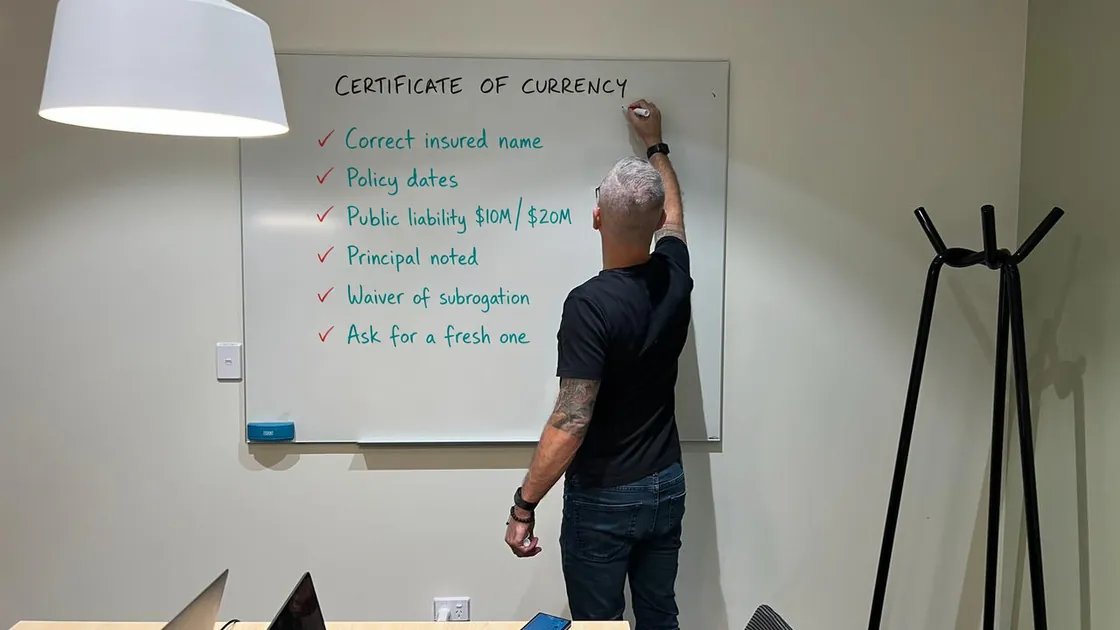
- The insured name matches your business exactly, the same entity that signed the contract.
- The policy dates are current and cover the job.
- The limit is the one the contract asks for, for example $20 million public liability.
- Any principal or stakeholder who asked to be noted is on there, spelled the way they spell it.
- Any waiver of subrogation or other wording the contract asks for is included.
Read it before you forward it. Technology can help with the errors, but you are still relying on a human at some point, so check the name, the dates and the limits yourself before you send it on.
What a Certificate of Currency Does Not Tell You
A certificate is fairly minimal. It is similar to the policy schedule, the summary page of your policy, though every insurer sets it out a bit differently.
It does not include the policy wording, the full document with the terms and conditions, and it will not list every inclusion and exclusion, so check those with your broker.
It will not show your claims or your premiums. It also will not show what other certificates have been issued or which other principals are noted, because those are handled case by case.
If you dig an old certificate out of your email from renewal six months ago, it will not show any endorsements added since. It is always better to ask for a fresh one.
What Happens If a Policy Is Cancelled Mid-Contract
If your policy is cancelled, tell your clients. The contract usually requires the people holding your certificate to be told.
A certificate only shows the cover on the day it was issued. It does not update itself, so a client holding an old certificate will not see that the policy has been cancelled.
Does the Head Contractor's Insurance Cover the Subbies?
It can, and most of the time it probably does. The head contractor's policy might cover subcontractors vicariously, meaning through the head contractor's own liability, but that is decided case by case.
So do not assume it. If you are a subcontractor, the head contractor will usually still want to see your own certificate of currency before you start.

Workers Compensation Certificate of Currency
If you employ people, a client can ask for a workers compensation certificate of currency as well as the one for your public liability.
According to the Australian Government's guide to business insurance, employers must get workers compensation insurance from an authorised insurer, and the laws vary in each state and territory.
The workers compensation certificate comes from your workers compensation insurer. It is separate from your public liability certificate under your transport liability insurance, so ask for both at the same time and send them together.
Held Invoices: Where a Missing Certificate Costs You
Where does payment get held up? If you do not have the right certificate of currency, the client usually will not process your purchase orders or pay your invoices.
A client will come to me and say, we need to prove our insurance or our invoices will not be paid. They may have already done the work and invoiced. They should have asked us for the certificate before going on site or starting the job.
The trouble is, if they have done the work but have not given us the contract, and we need to add wording, it might not be an hour or half a day turnaround. It might be a few days, with their invoices held up the whole time.
It is actually good that principals hold the money until the paperwork is right, because it means it is all authentic: when someone is waiting on money, they tell you the truth. Send us the contract when you win the work, before you start, and we can check what the certificate needs to say. Contracts often name a specific policy and a specific limit, so check which policy the contract is asking for before you start.
Certificates for Finance on Trucks and Equipment
If you are financing a truck, a trailer or a piece of plant, the lender will want the asset insured and usually wants to be noted on the certificate before it releases the money.
We can usually arrange a certificate noting the finance company quickly once the policy is in place, as long as their details are right. Lenders generally want comprehensive cover, which also pays for damage to your own truck, because third party only cover pays for damage to other people's property and does nothing to protect the asset they are lending on.
Frequently Asked Questions
A certificate of currency is a short document from your insurer confirming your policy is in place. It shows the insured entity, the dates the cover runs and the limits, for example $20 million public and products liability. Clients, head contractors and lenders ask for one before they let you start work, accept your tender or release finance.
Usually a client you are going to do work for, a head contractor or site you need access to, a tender you are putting in, or a finance company lending on a truck or piece of equipment. We also usually produce a fresh one at renewal.
It is a certificate of currency for your public and products liability policy, the cover for injury to people or damage to property caused by your work or your products. It shows the policy is current and the limit, usually $10 million or $20 million. Mining, construction and government contracts can ask for $30 million or $50 million.
Ask your broker or insurer. Tell them who it is for, whether anyone needs to be noted as a principal, and send the contract if you have it, so the certificate says what the contract asks for. If your cover is with us, get in touch and we will produce it, or a confirmation of insurance on our own letterhead if that is all your client needs.
Yes. They are the same thing, both issued by the insurer. When we confirm your cover on our own letterhead, that is called a confirmation of insurance, because we cannot issue a certificate of insurance.
Depending on the insurer and the type of policy, we can sometimes do a confirmation on our own letterhead very quickly. A certificate on the insurer's letterhead takes anywhere from a couple of hours to about 24 hours, depending on whether there are endorsements or special requirements, such as noting a principal.
It does not show the full policy wording, every inclusion and exclusion, your claims history or your premium. It also will not show other certificates issued or other principals noted, and an old one from renewal will not show endorsements added since. Always ask for a fresh one.
If you employ people and the client asks for one, yes. Employers must hold workers compensation insurance from an authorised insurer, under rules set by each state and territory. The certificate comes from your workers compensation insurer, separate from your public liability certificate, so ask for both together.
Many principals will not release a purchase order or pay an invoice until they have a certificate that meets the contract. If you start the work first and the contract needs special wording added, getting the certificate can take a few days, so ask for it as soon as you win the job.

Written by
Paul Cohalan
Founding Principal Broker, All Trucks Insurance
Paul is the founding principal broker at All Trucks Insurance, with more than 10 years broking transport, fleet and plant cover and an operational career in mining and heavy haulage before that.
Read Paul's full profile